The City That Never Stops Eating...

Back from NYC and other distractions! Our base in NYC is always the Historic South Seaport District – cobble stones, a view of Brooklyn Bridge from our room, close to pleasant walks by the East River, or along Battery Park. Typical in our trips to NYC is to take the #6 subway and emerge at Union Square. It is always on our ‘to do’ list since it features a farmer’s market teaming with interesting offerings from local / upstate farmers. Eye candy and educational. Wandering through the market is an assault on cravings, exciting salivary glands. 

What the heck is Yu Choy Sum? Read more...

What the heck is Yu Choy Sum? Read more...

This year, wandering through the market and continuing to circle around the square, I was struck by the overwhelming number of eating options in such a small space.  True, Union Square is a hub of humans – many being students as the Square sits among New School and NYU buildings. Nonetheless, there are a lot of options - though I am not saying they are all good... Check out some of the reviews. Not necessarily in this order – the second floor of Whole Foods is a café, Barnes and Noble has a large coffee room, there is a Dunkin' Donuts, a Starbucks, Panera Bread, TGI Friday, au bon Pain, pret a manger; even the Walgreens drug store has a coffee/snack counter. The Coffee Shop with its winding bar/counter and booths is open 23 hours a day. Once it’s past breakfast there’s The Republic, Blue Water Grill, the Union Square Café. Not to be overlooked are the food carts near street corners offering fare not unlike Tim’s in Canada. This year, I noticed two additions to the Square itself – Mighty Pie and the Pavilion Market Café – an almost al fresco space under a gorgeous old bandshell, aiming to use fresh produce from the market. If all that is not enough, the side streets puts one steps away from ABC Kitchen and ABC Cocina (where we had a fabulous meal), Gramercy Tavern, Eataly.  (Eataly may soon be coming to Toronto - yay!)

Ramen Burgers - crazy idea that works!

Ramen Burgers - crazy idea that works!

Enough already! This is such a tiny pocket of the city and not even what some experts would consider “restaurant central”. Clearly enough people eat at each of these places to pay the rent. NYC may be more deserving of the moniker “The city that never stops eating”!

It is, indeed, a challenge to stop eating at another “foodie must see/do”. Saturday is the day to hop on the East River Ferry, disembark at 6th Street and relish the sights and tastes at Smorgasburg – (no typo – smorgasbord + Williamsburg = Smorgasburg). In just a few years this has grown to 100 vendors. It is supposed to begin at 11, but this may also be the city that sleeps in! (Noteworthy that a lot of things don't open until 11.) On the dot of eleven, not all vendors were ready for commerce – some arriving almost an hour later. But most - like the porchetta guys - are worth waiting for, and easily forgiven. It’s advisable to wander before deciding what to eat, and best to opt for sharing, thus leaving optimal tummy room. A couple of “firsts” this year – artisanal beer battered cheese curds (with spicy mayo dips) and Ramen Burgers. I was expecting buns pressing on noodles. Instead the noodles formed the “buns” enfolding a meat patty and all the trimmings. Doughnuts from Dough - deadly.

Toast at the Studio Cafe

Toast at the Studio Cafe

Another memorable meal was at Lafayette. The celebrated chef and cookbook author, Andrew Carmellini, offers up an entirely different ambiance and experience from The Dutch - where we ate last year - with French rather than Italian influences. At the newly (re)opened Whitney Museum, the talents of Chef Michael Anthony (of Gramercy Tavern fame) make eating “artful” – both at the Studio Café and the restaurant, cleverly name “Untitled”. For a good part of the Spring, “toast” ideas were trending on Twitter, but I had not anticipated they’d show up on a menu. Various toppings on thin, dense, brown crusted, toasted, crispy bread were gorgeous to behold and even better to devour. 

 I’m betting that Ramen Burgers and “toasts” will be appearing on menus near here soon!

Zaitzeff - not your ordinary burger joint.
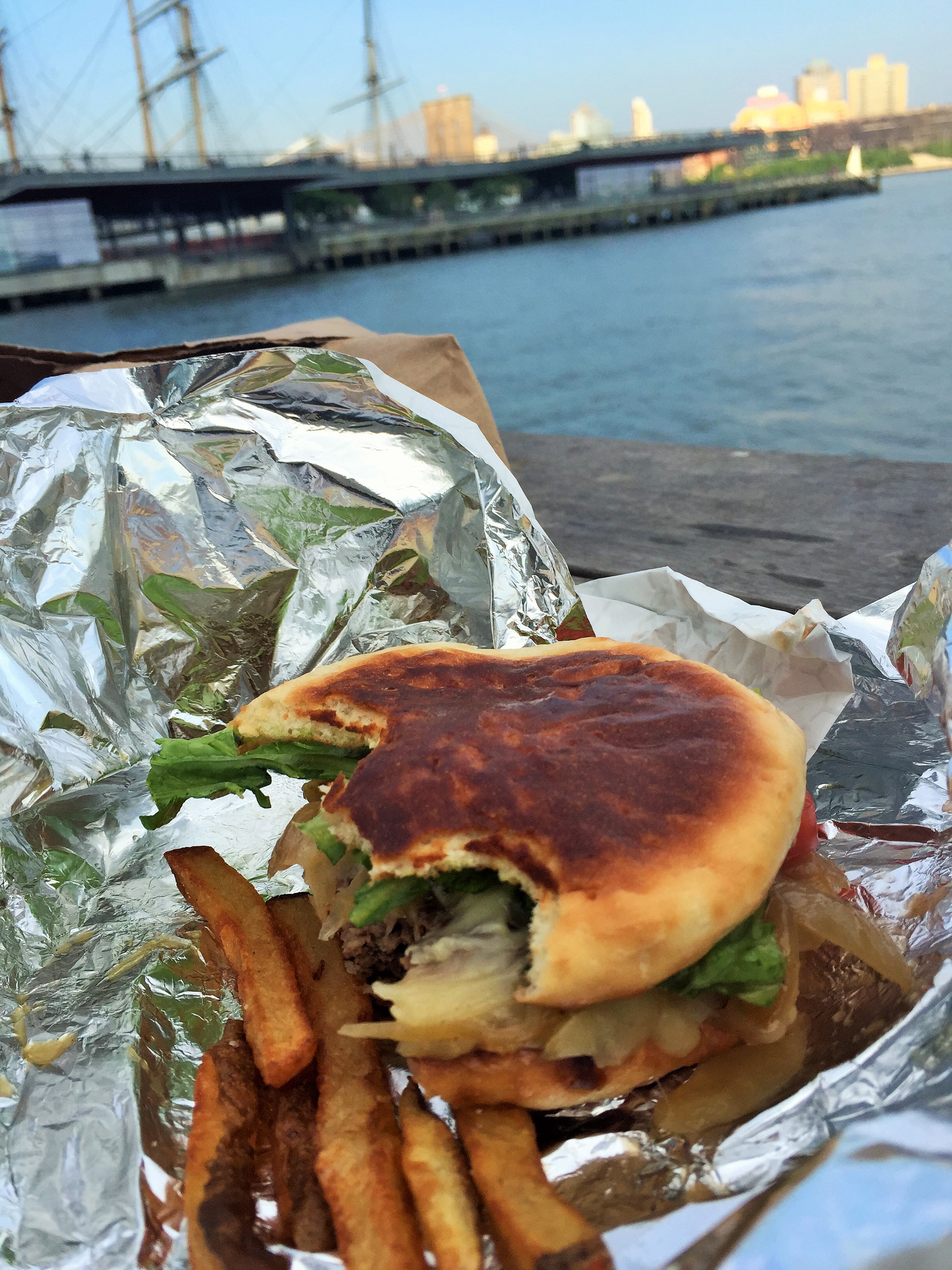
Zaitzeff - not your ordinary burger joint.

Burgers, Brooklyn Bridge and East River

Burgers, Brooklyn Bridge and East River

Also noteworthy is the amazing Zaitzeff Burgers – sirloin burgers, caramelized onions, cheese on a Portuguese bun! There once was a resto in Burlington that used Portuguese buns for all their sandwiches. I need to dust off my quest to discover where one can buy these. [Update: I figured out how to make these!! Check out my recipe!]

Adding to an already long blog post, will mention the Gansevoort Market near the Whitney. (The Chelsea Market is also nearby – though they are a bit more like “emporiums" than farmers’ markets.) Steps away is the southern end of the High Line – a great NYC concept offering a lovely walk – best on a weekday.

I end every post with a recipe and the one that seems most fitting is the sweet treat that is quintessentially NYC – Black and White Cookies. They became known to most of us from Seinfeld. They can be good or bad and the best bet is home-made. I used to use a Martha Stewart recipe, but for this occasion decided to try the recipe from America’s Test Kitchen. A great recipe, with one problem – they can vanish in 24 hours!

(Having traveled often to NYC, I have tons of travel and foodie tips – most already typed up since I share them so often. Let me know if you have specific questions or would like the KB Tip sheet! I will also add resto, markets and foodie shopping info to other parts of this site. As I do, I will come back here and post links.)

If you enjoyed this read, please take a second to click on "Like" - makes me happy!

I invite you to Share and Comment!
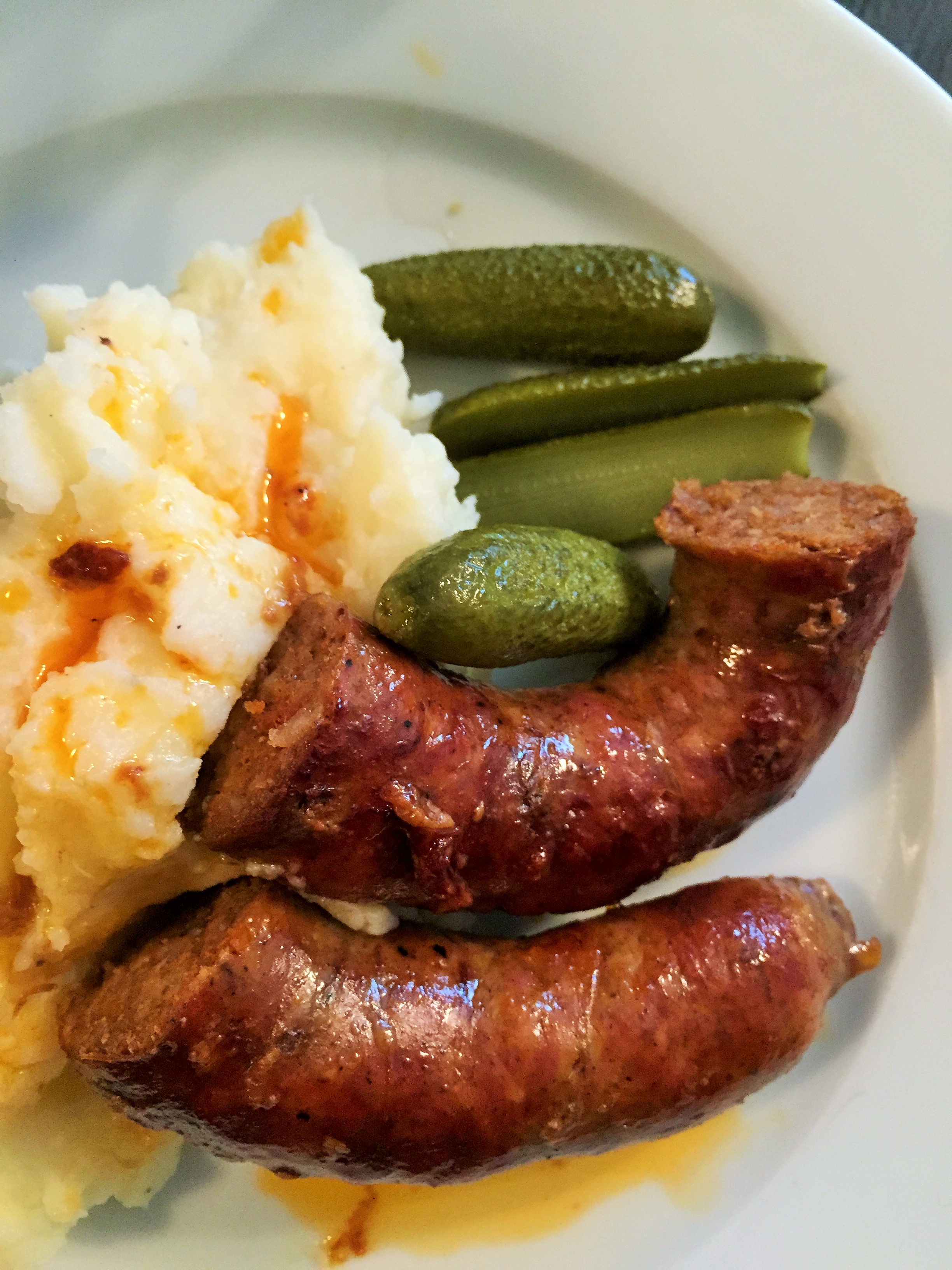
Sausages - best or "wurst" food?

Been thinking about (and making, eating) sausage lately. The recipe I share at the end calls for removing the meat from Italian sausages. I have always found that to be odd – so much trouble to put the meat into the sausage casing – why take it out!?

Who invented sausages anyhow and why? Even before researching, I figured that animal intestines (natural casings) must have been a handy way to store bits of meat linked to butchering. Easy to imagine that once those little bundles of meat were preserved – smoked, for example – they would have been a safe and handy food source. Much to the despair of food trucks fighting City Hall in Toronto, that may be why sausages continue to be the most readily available street food in the “Little Apple”. The craving for more diversity in Toronto street food, should not be taken as a dislike for sausages. Wvrst has been abuzz with patrons each time I have visited, and a new generation of butchers and sausage makers seem to be thriving – take for example, this recent article (and video) about Bespoke Butchers in Liberty Village.

Sausages have been around for thousands of years, in every culture that butchered animals. Meat, tissue, organs, scraps and blood were stuffed into (cleaned) intestines or stomachs (e.g. Haggis). 

A core set of sausage types is linked (no pun intended) to cultural traditions – but enjoyed by all. Chorizo, for example, is no longer a favourite only with people of Spanish/Portuguese origins. Imagination now seems to be the only limitation to sausage ingredient combinations.

Sausage can be fresh, or some combo of smoked, cured, fermented, dried, aged. The main ingredient may be pork (most common), or beef, lamb, chicken – and there are even vegetarian sausages. Sausages are part of the charcuterie food trend which has experienced a renaissance in recent years. A new generation is rescuing traditions at risk of being lost – and, in part, that is why I sometimes make sausages.

Sausage making used to involve my grandparents and parents. My grandfather went so far as to build a smokehouse at the back of his property – I have no idea if neighbours ever complained. I have one memory of a three generation sausage making session, then just two, and now I have all the equipment – what is one to do?

Technically, this is Italian sausage - no paprika in sight...

Technically, this is Italian sausage - no paprika in sight...

I live in a city with a fairly large Italian community. While sausages can be made year-round, every January / February local grocery stores sell pork butt and casings, and thus we are motivated to haul out the equipment – some of it made by my Dad. The family tradition includes making Hungarian kolbasz (pork flavoured with paprika and garlic). We have added Italian sausage to the repertoire.

Once the meat is ground and flavoured with spices, there are various “tools” used for stuffing the casing. A sausage stuffing device consists of a canister for the meat, a plunger and a funnel (onto which the casing is pushed, ready to be filled). Unhappy with the size of canisters, and wanting optimal control over the plunger, my Dad made his own. It’s an heirloom to be treasured.

One classic Hungarian sausage we have not yet made alone is Hurka (hoorkah) – a flavourful concoction of rice and onions and liver. [Update: Hurka recipe now on this blog.] “In the day”, organ meats were sometimes added. Such nose-to-tail eating has also experienced a comeback - supported by many talented chefs, notably Fergus Henderson and April Bloomfield - though she is currently on book tour with her new book - "A Girl and Her Greens". Locally, Jennifer McLagan has added "Odd Bits" to her acclaimed publications.

I have a memory of my grandmother washing a lung before grinding it into the sausage mixture for hurka. If the grinding was not to my liking, and I encountered a wee hunk of lung – out it came, though I still liked the sausage. It has been said that hurka is not unlike haggis which contains “sheep's pluck (heart, liver and lungs); minced with onion, oatmeal, suet, spices, and salt, mixed with stock, traditionally encased in the animal's stomach and nowadays often in an artificial casing.” (Source). I have never had haggis, but won’t be shy if ever presented with the opportunity.

It's hard to resist the cute little bundle of pepperettes, wrapped in kitchen twine, next to the register of Sanagan's Meat Locker in Kensington. But, truth be told, I could maybe, maybe live without eating sausage. In part, that is because my tummy is not always happy with purchased sausages. I know exactly what goes into ours. The casing is natural – not artificial. Everything I know from food handling certification is in full force, and once ready they are stored frozen. When homemade runs out, I trust a local Italian vendor who makes his sausage daily and once it is sold out, you must wait for tomorrow.

How do you spot a good sausage? "The meat,’ says butcher Andrew Poulsen. ‘With no filler. When you mix in things like breadcrumbs, eggs, stabilizers — they all deteriorate the quality." Sausages destined to be dried are cured using curing salts (sodium nitrate/nitrite) to prevent botulism, and while this is not required with fresh sausages, some butchers add it. The addition of nitrates/nitrites is controversial. Not all countries agree on regulations, and producers who use them offer assurances re quantities and remind consumers that some vegetables have more nitrates than cured meat.

Kolbasz - cooked in a pie plate in the oven

Kolbasz - cooked in a pie plate in the oven

Other things may also be added to sausages. In the UK, “sausages” must contain 32 - 80% meat. So when is a sausage not a sausage? UK television personality Marc Sage explores why “bangers” (as in bangers and mash) are not officially sausages. Endure the first few goofy minutes of this video, and watch as he proceeds to make a banger according to legally permitted ingredients. It seems like nothing anyone would want to eat – yet taste testers give it a thumbs up!?

I fear some readers may never want to eat a sausage again, but perhaps in time will not be able to resist the juicy succulence of a sausage – which seems always to be paired with a carb – a bun, wrapped in a pastry, potatoes or pasta. Google ‘pasta with sausage’ – over 43 million results. Somebody must like it! This Orecchiette with Sausage / Tomato Sauce has come out of our kitchen countless times – and is even a hit with guests!

If you enjoyed this read, please take a second to click on "Like" - makes me happy!

I invite you to Share and Comment!

When It Comes To Crunch

I need crunch. Every day. Crunchy... crispy... - how do I love thee? Let me (re)count some of the ways.

  • potato chips, of course. It is true – you can’t eat just one – which is why they are almost never in my house. (Occasional exceptions are made for Covered Bridge Potato Chips from New Brunswick - home of 60 covered bridges, including Hartland - the world’s longest). 
  • perfect French Fries – and the award goes to Jamie Kennedy who recently ended an era in the Toronto food scene with the closing of Gilead. In related interviews, he recounts that his fries were inspired by his time in Paris. His two sons continue the tradition every Saturday at the impressive and unique Evergreen Brickworks Market.
  • pork crackling, most notably the little piece that appears in every porchetta sandwich at Brooklyn’s Smorgasburg. Yes, “burg”, not “bord” – named as such since the indescribably wonderful flea and food market is in the Williamsburg neighborhood of Brooklyn
  • super crispy wiener schnitzel – cravings were satisfied by the Coffee Mill (sadly, recently closed forever)
  • the crunch from the crust of freshly baked bread
  • vegetable crunch is also good – the first crop of coreless carrots; celery hearts – when fresh, are crunchy and can be nicely enhanced with crunchy peanut butter; radishes - freshly harvested, with a sprinkle of salt
  • and my favourite apples – aptly named Honey Crisp

It seems I am not alone. 

According to Mario Batali (in The Babbo Cookbook), "The single word 'crispy' sells more food than a barrage of adjectives describing the ingredients or cooking techniques."

Eating triggers many senses – visual (we want our food to be “eye candy”); aroma (helpful in triggering digestive juices). Flavour (the artful combination of the basic tastes - sweet, salty sour, bitter and umamai) may not be the most important sense. Texture (and often the accompanying sound) can trump all – and there is an entire industry focusing on that.

An article on food texture in The Guardian refers to the "Texture Centre of Excellence help(ing) the food industry achieve the perfect consistency for their products. Texture is big business and the science of food structure even has its own ology: food rheology... the professionals know all too well that, while the sensory spotlight may fall on flavour when we're savouring a mouthful, get the texture wrong and it's game over – we'll reject it outright.

Why do we like crunchy and crispy? It tends to signal freshness. And then there is the matter of chewing. The word conjures iconic images of cows chewing cud, but it seems we need to chew, and that need "continues right through to old age when... we'll throw cash and inconvenience at fixing our teeth so we may continue to chew, even though we could just as well get our nutrition from soft or pureed foods. Gnawing is… good for you, too. A growing body of research indicates that it increases blood flow to the brain, which helps stave off dementia.” (Source)

While some write haikus honouring mush, others claim it is almost tortuous to be limited to mushy food - “a form of sensory deprivation… the mind rebels against bland, single-texture foods, edibles that do not engage the oral device.” (Source) A food industry consultantsays the three most relished texture notes are crispy, creamy and chewy”. I like all those words, as long as "chewy" does not equal rubbery.

Rubbery. Gritty. Slimy. Not big hits with most people. I could not find a satisfyingly complete lexicon of food texture words. This British Nutrition Foundation Sensory Vocabulary poster makes a good attempt, but oddly does not include the word chewy. Think crunchy is the same as crispy? Apparently not, according to Wikipedia.  

So, we like crunchy / crispy because of chewing, and… because of sound! There are experts who spend years researching topics such as how crunch works. “To get this noise, you need crack speeds of 300 meters per second... The speed of sound. The crunch of a chip is a tiny sonic boom inside your mouth… to a certain extent, we eat with our ears… You eat physical properties with a little bit of taste and aroma. And if the physics is not good, then you don’t eat it.” (Source)

The happenings in our mouth while eating are called mouthfeel - also referred to as oral haptics. Recent studies suggest that oral haptics influence our judgement about calories. People tend to assume that crunchier food has fewer calories. Maybe my crunchy food moments are also a calorie delusion!

The appeal of crunchy / crispy is cross-cultural and may even be primitive. In his book The Omnivorous Mind: Our Evolving Relationship with Food, John S. Allen, a research scientist, proposes that we like crunch because it was central to the primitive diet - in the form of insects. Once insects (and other foods) met fire / cooking (and the Maillard Reaction) crunch became part of the human experience. I’ll have to ponder the idea that the love of crunch is the manifestation of the paleo insect-eater inside each of us. And yet, simple Google searches can lead to a reading journey about insects as the future food. Once the renowned René Redzepi begins to explore possibilities, we know we have not heard the last of this.

This blog exercise in thinking, reading and writing came from my need for crunch. Most days that need is satisfied by roasted, unsalted (healthy) almonds. Seeking some variety, I had some adventures roasting legumes (good for us), specifically chickpeas – and have also included a roasted edamame snack. (Click here for recipes.) Healthy snacks can make us feel virtuous, but too much virtue comes with a price – watch the calorie count.

If you enjoyed this read, please take a second to click on "Like" - makes me happy!

I invite you to Share and Comment!


Hurry Up (Schmecking) Chocolate Cake

My (not so profound) observation about writing a blog is that I am often wondering what the next entry will be about. I don’t have a stack of ideas waiting to be “published”. Often there is a pleasantly surprising convergence of ideas and events.

I am the youngest person at Tai Chi and admire the joie de vivre of members in their 80s and even older. When Jennie (82) told me she was taking her husband on a bus tour of Mennonite Country it triggered a whoosh of memories – and naturally, that involved food. Around here “Mennonite Country” means St Jacob’s and Waterloo County - the Mennonite Relief Sale (featuring unforgettable strawberry pies), the Mennonite / St Jacob's Farmers' Market – ten minutes from the Kitchener Market – a community noted for a huge Oktoberfest celebrating German Heritage. In fact, almost one hundred years ago, Kitchener changed its name from Berlin.

Converging with these memories were updates from Food52 about their 2015 Piglet Tournament of Cookbooks (I have no idea why it is called that). Over a period of three weeks, sixteen cookbooks were reviewed, leading to one winner. (A bit like a more complex “Canada Reads”.) In conjunction with that, the Food52 blog asked readers about oldest / most worn cookbooks. For me, the cookbook(s) linked to Mennonite Country are those from Edna StaeblerFood That Really Schmecks and More Food That Really Schmecks – both easily survived my cookbook purge of last year. With red-face, I confess that these days I prefer cookbooks with lots of photos – food porn, as it is now referred to. There is not a single photo in Edna’s books. She clearly announces in both books that she is not a trained cook. She said she loved cooking with “blissful abandon” (wow! Kitchen Bliss 1.0). Today we might say that she “curated” these collections of hearty, rustic and tasty (schmecking) recipes, that use local produce – saying she did not include any recipes that required some exotic import - such as kiwi - or a processed ingredient.

She must have been an impressive woman. Born in 1906, in what was then called Berlin, she achieved a university education and teaching qualifications. She was an accomplished author and wrote for many well-known Canadian publications. The cookbooks, she says, were an unplanned, but satisfying “accident”. As with many (good) cookbooks, the introductory chapters are a delight to read and I was happy to re-visit these pages, where she described friends from the Mennonite community (founded by families that migrated north from Pennsylvania - and originally from Europe). She waxes rhapsodically about her beloved Waterloo County and its entrepreneurial roots. Edna died in 2006 at the age of 100, and so she lived long enough to see her community grow – including as the home base for Blackberry / RIM and the Perimeter Institute for Theoretical Physics.

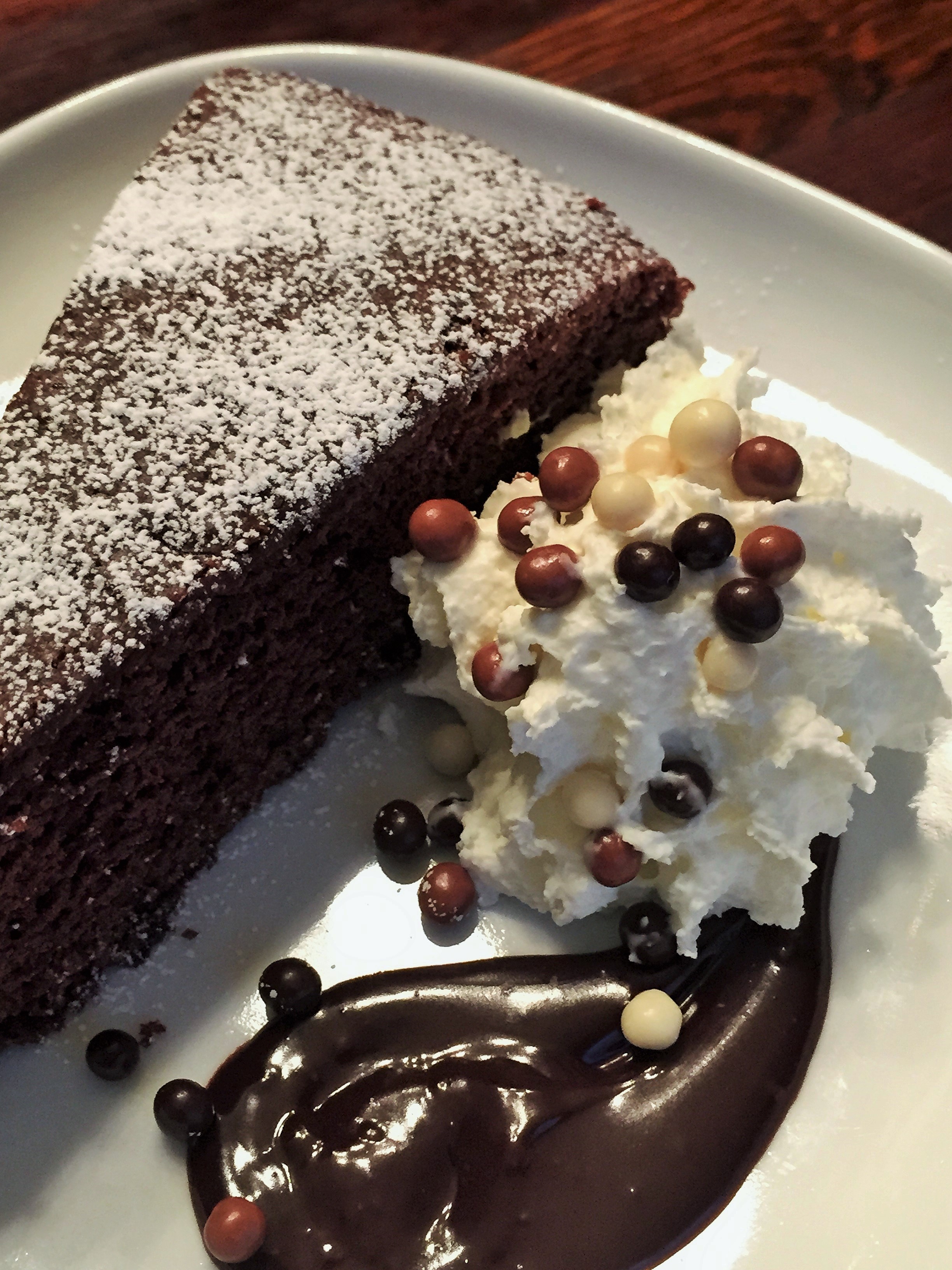
But I digress from the topic of food... There are many pages with folded corners in her books. Some I will return to in future, but the one that made it onto the Easter menu was Hurry Up Chocolate Cake. This cake is quick - and clean – the only thing dirtied in the making is the baking pan. Edna included it in one of the books, it seems almost reluctantly, saying “you probably have this recipe…”. I’m glad she shared it, since it has been made and devoured countless times in my kitchen.

One final “convergence”… The recipes in the “Schmecking” books are “old”. The second of the two volumes was published in 1979, and Edna’s preface outlines the venerable roots of many of the recipes, passed from generation to generation. About the same time that I was lost in reverie in this old cookbook, I stumbled across The Wacky Cake recipe. It too is a one pan chocolate cake that requires the cook to make little “craters” in the dry mix into which the wet ingredients are added – same as Edna’s! The cake was considered wacky because it uses no eggs, butter or milk – and the guess is that it dates back to wartime rationing. There are some differences between the two – she uses buttermilk (she seems to love using buttermilk or sour milk), whereas the America’s Test Kitchen Wacky Cake Recipe uses water and oil. In another entry, ATK says “We chose water over milk or buttermilk to moisten our cake batter, discovering that cakes made with dairy had a more muted chocolate flavour.” I have had no time to check this out – but will report back!

If all of that was not enough of a “blast from the past” – this weekend we have reservations at Boralia (some reviews call it Borealia) – a TO resto that “celebrates the historic origins of Canadian cuisine. Our menu draws inspiration from traditional Aboriginal dishes, as well as the recipes of early settlers and immigrants of the 18th and 19th centuries.” Will report back on that as well!

Now… hurry up and make that schmecking chocolate cake!