Flummoxed About Fat

Last week an earthquake registered off the coast of Vancouver Island. Media reports referenced the location’s proximity to a point where the Juan de Fuca plate attempts to slide under the North American plate. None of the news articles felt the need to explain plate tectonics – now considered to be a well-known, accepted geophysical fact. Yet in my lifetime this was not always so. Elements of the theory were proposed in the early 1900s, but even in the 1960s ideas such as continental drift were considered by some to be unconventional and unaccepted.

“Truths” linked to “science” can evolve and change, and “truths” about health and food are no exception. Who could blame us for feeling flummoxed, with questions that have too many conflicting answers? Is Vitamin D good? Should we restrict cholesterol? Should we eat many small meals a day? Is red wine and dark chocolate good for us? Nina Teicholz’s recent publication called The Big Fat Surprise outlines and adds to growing research that fats are good for us after all (including some saturated fats). [Warning: vegetarian friends may consider some of what follows, coarse language.]

Despite the mantra all researchers should live by – “correlation does not equal causation” – Teicholz outlines how the origins of some claims about health and food can be traced back to faulty observations and assumptions. Easter and Lent, it seems can, in part, be blamed for a decades old demonization of fat. “In the early 1950s… (a) scientist believed he found, in part by studying a group of men on Crete… that their good health and low rates of heart disease were due to a diet low in animal fats…Pouring over some of Keys’ original studies, Teicholz realized his work was partly based on men who had been observing Lent - a time when Cretans dramatically reduced their consumption of meat and animal fats.” (Source)

This blog post is not intended to change any reader’s attitude toward fat. For me, the new “truth” about fat makes me feel better about my full fat choices (and childhood.)

Nagypapa | szalonna sütés | Queenston Heights

Nagypapa | szalonna sütés | Queenston Heights

I have already blogged about my childhood obsession with butter. Bacon was another fat linked to fond memories. My grandfather’s fridge always had a huge hunk of bacon, sometimes called slab bacon (cured and smoked). He would cut little pieces for me (what the French would call lardons) and place them on slivers of rye bread, and called them kis katona (little soldiers). A bacon roast (szalonna sütés) involved putting slab bacon on a stick, and cooking it over a fire. Every few minutes the fat from the bacon was dripped over slices of rye bread that was smothered with a mixture of tomatoes and onions. Incredible! 

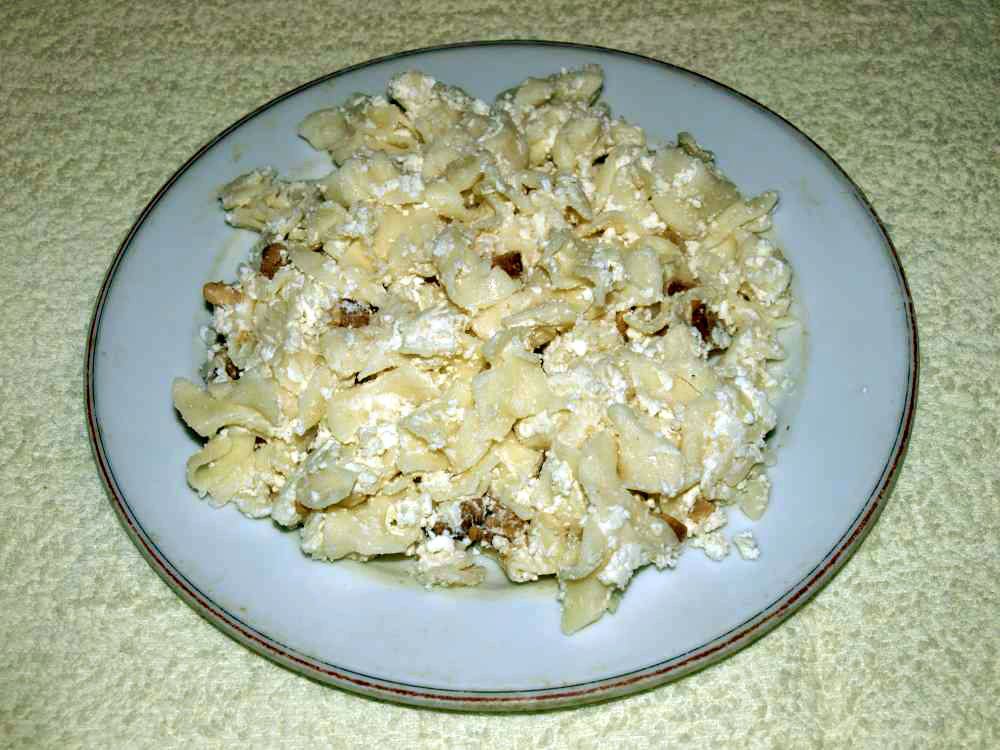
I did not have a “meat and potatoes” upbringing. Many meals were meatless – Hungarian kitchens produced a lot of creamed vegetables and pasta dishes. Almost anything could be mixed with cooked pasta. Túrós tészta / csusza involved mixing pasta with ricotta and a bit of sour cream, sprinkling with bacon lardons, and drizzling with bacon grease. I preferred this pasta / ricotta combo with sugar (oh dear, another evil) instead of bacon grease. Considering that celebrity chefs like Lidia and Jamie drizzle olive oil over so many things, funny that the idea of a “bacon grease drizzle” still does not appeal. I am not convinced too many readers will want to make this, but here is a link to website with a version of the recipe

 Túrós tészta | Source

 Túrós tészta | Source

Government websites still list saturated fats as “bad”. This doesn’t seem to bother those adopting the latest café craze – butter coffee – especially popular in wellness oriented coffee shops. Some of my recent recipe testing assignments are intended for a cookbook promoting the Paleo lifestyle, and they all use coconut oil - listed on both Canadian and American websites as bad saturated fats to be avoided.

Teicholz researched her book for almost ten years, but “isn't optimistic that change will come easily. The clean eating food movements, led by the Michael Pollans and Mark Bittmans, are hugely influential.” Mind you, a Pollan saying is “Don't eat anything your grandmother wouldn't recognize as food.” Unwittingly, he thus gives me permission to continue eating full fat products. I won't apologize for the fact that some of my recipes begin with a tablespoon of lard, or duck fat. And I'll consider bacon eating moments to be a tribute to my grandparents!

P.S. This past week seemed to be “fat week”. With breakfast, I read about Lee’s Ghee, and encountered Lee later the same day at the One of a Kind Show. I bought some of her Ghee with Dates. Poor thing was subjected to a Twitter lambasting for appropriating a food not linked to her culture. The so-called #gheegate finally calmed down with people supporting her right to make and sell this. She says her products are great for cooking / baking (she offers recipes) and with coffee, and on popcorn!

If you enjoyed this read, please click on "Like". I invite you to Share and Comment!

[Bacon image source]


The Most Gratifying Dish...

"Almost every culture has its own variation on chicken soup, and rightly so - it's one of the most gratifying dishes on the face of the Earth." Yotam Ottolenghi (Source)

It’s fitting that it is Sunday as I write / post this. Growing up, the midday meal on Sunday was always, always chicken soup. The task of making the soup passed from my Grandmother to my Mother. Once I left home, chicken soup did not routinely appear on my own dining table until I had a family. The hosting of family events moved to my home and I inherited the giant soup pot needed to make enough for firsts, and seconds, and "take homes". Eventually, my brother became the maker of chicken soup for family events – and he still makes it regularly for his own family especially in the “brrrr” and “eey” months - September to February.

The recipe has never been written down. It begins with a soup pot and water to which were added full chicken legs (skin on - and sometimes chicken backs, necks if any were on hand). The water was slowly brought to a simmer and this was the absolute most important stage of the soup-making – the cook was not allowed to be distracted. As the water and the chicken warmed, a foamy scum would rise to the surface. Google “foamy scum on chicken soup” if interested in the science. I once heard Julia Child say it was not necessary to skim that off, but in my family we always did, using a little strainer. Once that stage ended, we added carrots in large chunks, celery, a bundle of parsley, salt and whole peppercorns. A whole onion with a layer of skin was added – this gave the soup a warm hue. Also added were thick slices of kohlrabi. (In time, we became privy to the "secret" that both grandmother and mother added some chicken broth powder. We never tracked down the product they used, and as far as I know it no longer exists.)

The soup was served as a broth with noodles – and for family occasions, the noodles were very special - handmade csiga (cheegaw) – the Hungarian word for snails - so-named because of the pasta's inexact resemblance to the creature inside the shell. This pasta was painstakingly made by my grandmother, and then my mother. I can recall helping a few times, but by and large it was a time consuming task my mother undertook as a family occasions approached. My father created a tool that sped up the cutting of the pasta into little one inch squares. He also made the grooved little boards that were used to turn /roll the wee pasta squares. The final step was to spread the “little snails” onto a floured sheet spread over an un-used bed – and there they stayed for several days until thoroughly dry. Now csiga can be purchased at local delicatessens, but they are clearly machine made and a pale imitation of home-made.

Home-made tools

Home-made tools

It has been over three years since we ate the last of the handmade csiga, and while I know how to make it and have inherited every single tool, I admit I have not yet been motivated to take on that family tradition. The soup was eaten as clear broth with the csiga. A platter brought to the table served up the “soup chicken”, carrots and kohlrabi that everyone could add to their bowl as they wished.  Mind you, the soup chicken was often the second course – eaten with boiled potatoes and a paradicsom martas – a sauce made of sour cream, flour and a sort of tomato passata (which was home cooked in tomato season and bottled into old beer bottles for use year round).  Oddly, I used to find that sauce to be a bit tart and sprinkled sugar onto it!! Was that weird? I just Googled chicken and sugar – and shockingly there are quite a few recipes that enhance the chicken eating experience with sugar! Who knew!?

It’s a mystery why chicken soup can be so comforting. We make it very often, and for some time have favoured the LooneySpoons version. In this blog post, I am announcing that a new chicken soup recipe has taken the number one spot. It is much closer to the food memory of my childhood. The soup begins with schmaltz – which I could not find, but the internet claimed that goose fat was an acceptable substitute. I have now make this with both duck fat, and also (once I found some) with goose fat. Initially, I could not find matzo meal and so made griz gomboc (greeze gumbowtz) which are Cream of Wheat dumplings - common in Hungarian cuisine. 

Try this recipe for Chicken Soup with Herbed Matzo Balls (or griz gomboc) and if it doesn't leave you feeling comforted, satisfied and gratified, I’ll eat my… soup.

If you enjoyed this read or the recipe, please click on "Like". I invite you to Share and Comment!


Irish in Another Life?

IMG_2472.JPG

Am rounding out my bread-making streak with Irish Soda Bread, in honour of the day. Up until my recent forays into yeast breads, this was the only bread I ever attempted, using a (lost) recipe from the (sadly) now defunct Gourmet Magazine.  (Update - am happy to report that I found my original recipe from Gourmet and so have shared that also!) Still obsessed with the ATK / Cook’s Illustrated, All Time Best Bread Recipes publication, I decided to try theirs.

In a recent interview on CBC, America’s Test Kitchen’s Christopher Kimball acknowledged that they spend on average $12,000 testing each recipe – that represents hours of (hu)manpower and ingredients. End result, in my experience, has been that their recipes are reliable and almost foolproof. I say ‘almost’ because I can sometimes find some way of goofing things up a wee bit.

I began to make Irish Soda Bread after our first (of several) trips to Ireland. I have always been much more drawn to walking on cool windy beaches than hot southern ones. I can’t be the only person who has felt an inexplicable peaceful bond with a place they visited. Though I have no known Irish genes, I always felt at home there, and used to joke that I must have lived there in another life. (As a footnote, my brother loves green, celebrates St. Patrick's Day, and is always fêted by his family on this day. Maybe there are some Irish genes lurking in there somewhere. My daughter-in-law just reminded me that she is 40% Irish - too bad she's not here to break bread with me.)

Gap of Dunloe, Source Tom Pulman

Gap of Dunloe, Source Tom Pulman

Once we had children, we took them there. As a child, son #2 had bright red hair and for the first time saw many other youngsters who “looked like him”. Hiking in the Gap of Dunloe we achieved five minutes of fame as we were featured on an Irish travel show. We were meant to be an Irish family and they felt it necessary to drag a few more kiddies into the shot – seemingly, at the time, an Irish family was unlikely to have only two children!

A “fresh bread” craving can be quickly satisfied by this bread. In Ireland, it appears at all meals – next to stew at supper time, and with breakfast. It is a slightly sweet bread, so I like it best with butter and jam – of course that can be eaten at breakfast, lunch and dinner and snacks – yay! Happy St. Patrick's Day! Sláinte!

Here's the recipe. If you enjoyed this read or the recipe, please click on "Like". I invite you to Share and Comment!


Three Cheers for Broccoli - Three Ways!

It was soup day again, and we were still surrounded by white (snow) – wishing for green (Spring). There was broccoli in the fridge and so broccoli soup became the main item on the menu. My Dad used to like broccoli soup. It was years ago that I had tried to make some for him. Each attempt tasted fine, but the gorgeous green more often than not transformed into the less appetizing olive green colour. It was only in recent years (when he was no longer with us) that I settled on the Podleski Sisters’ version of broccoli soup. 

Broccoli is part of the cabbage family – wait until I have time to share cabbage recipes – yum. So far, every time I research something for this blog, I discover it is an ancient food – and broccoli has been around since the 6th century BC! Italians seem to get credit for cultivating and popularizing broccoli, which “was first introduced to the United States by Italian immigrants but did not become widely known there until the 1920s.” (Source)

As grown ups, many of us likely began reaching for broccoli more often when we discovered it was a great source of vitamin C and fibre, and had anti-cancer properties. It appears on (and tends to disappear from) every veggie tray, at every event / meeting. Yet, people of a certain age may have bad memories of poorly prepared and unappetizing cooked broccoli – often not a kiddie’s favourite. If you’ll pardon the old joke: “What’s the difference between boogers and broccoli? Kids don’t like to eat broccoli.” (badda boom!)

I am sharing the recipe for Looneyspoons reasonably low cal, yet flavourful broccoli soup. It uses the florets only. What to do with the stalks? If I was a clever girl, I’d add them to a freezer bag, saving up veggie scraps to make a homemade veggie stock – but I am not that clever. And yet, it seems wrong to toss the broccoli stalk. Here’s what to do – keep the stalks refrigerated until you accumulate 3-4 stalks and then make Jacques Pépin's Risotto with Broccoli Stalks and Mushrooms.

If suddenly it is the broccoli florets that are luxuriating in the refrigerator – they are great eaten raw with Buttermilk Ranch Dressing as a dip, or can in minutes be transformed into a tasty side with this Optimum Health recipe.

Three recipes, and three cheers for Broccoli!

If you enjoyed this read and/or the recipes, please click on "Like". I invite you to Share and Comment!