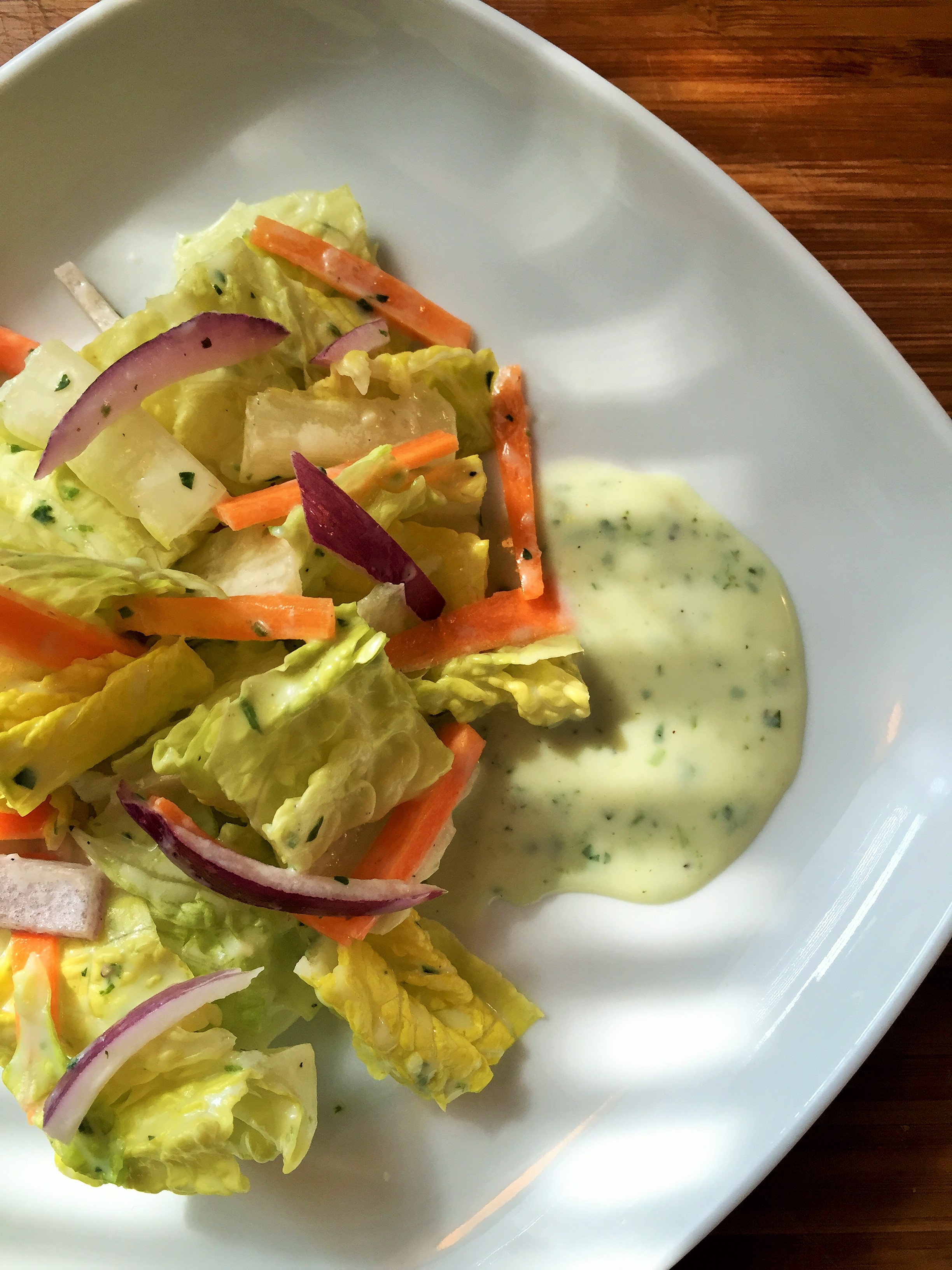
National Ranch Dressing Day

Yup. According to Foodimentary, March 10 is National Ranch Dressing Day - though "National" may be referring to the nation south of the 49th. Visit that site for trivia about this salad dressing invented in 1954. It is one of my favourite dressings and it seems I am not alone - it has been the most popular dressing since 1992. The big shock is that according to the Foodimentary guy (John-Bryan Hopkins) "While popular in the United States and Canada, Ranch Dressing is virtually unknown in most of the world"!! How can that be!? 

A sad fact about Ranch Dressing he does not mention is that store-bought can be super high in calories. I am calorie-aware. I know the calorie count of most everything I eat. That doesn't mean that I avoid things high in calories.  The strategy is to lean towards nutrient-loaded calories, and permit treats.  As much as I like salads, I figure why "waste" all my calories on the salad dressing. Typical store-bought Ranch Dressings are 120-140 calories per 2 TB. I'm sharing an easy dressing that can be made in minutes and it clocks in at only 34 calories for 2 TB!  So, if I am going to consume 140 calories I can make it store bought dressing - period - or my home-made dressing plus 1.5 Chocolate Walnut Cookies! (smiley face)

Central to authentic Ranch Dressing is Buttermilk.  "Originally, buttermilk was the liquid left behind after churning butter out of cream" (Wikipedia) so there's no butter in buttermilk! Producers are concerned that it's popularity might be waning. It seems, then, that I am among the minority that like buttermilk and don't mind drinking it alone. There is often a carton in my fridge and it has a long shelf life. In truth it is in my fridge less for drinking and more for recipes. Buttermilk figures in many of my favourite recipes - Irish Soda Bread, Party Plum Cake and Red Velvet Cake. I don't often make the following, but there's buttermilk pancakes and biscuits; it's a terrific marinade for chicken - especially chicken destined to be fried.

Without buttermilk there'd be no "red velvet cake". (I will soon share my recipe for this.) The reaction between buttermilk and natural cocoa powder results in a reddish cake - and these days the colour is often enhanced with some food coloring. (Read more)

Buttermilk is often used together with baking soda, for example in Irish Soda Bread. It provides the acid that activates baking soda and the resulting carbon dioxide is what makes whatever's being baked, rise. There was a time when the only way to introduce air pockets to dough/batter was using yeast, and yeast action demands time - thus, slow breads. With the introduction of baking soda came the dawn of "quick breads". But what if there was no buttermilk (or another acid) to activate the baking soda? Along came baking powder which combined baking soda with two powdered acidic components. All this was happening in the 1800s and guess who popularized this in Europe? "August Oetker, a German pharmacist, made baking powder very popular when he began selling his mixture to housewives... Oetker started the mass production of baking powder in 1898 and patented his technique in 1903." And that's where the story began for Dr. Oetker - a family-owned company headed today by a fourth generation real Dr Oetker. How they ever got into making frozen pizza is another story...

Whew! Feels like an episode of "Connections". We went from Ranch dressing to buttermilk, to baking soda and baking powder to Dr. Oetker and to pizza - and it is with pizza that I have my salad with Ranch dressing! Time to make this Buttermilk Ranch Dressing - which, thanks to the buttermilk, is high in probiotics and low in calories. Here's the recipe - and if you tire of this as a dressing - it makes a great veggie dip. In honour of National Ranch Dressing Day, I suppose I must share that your local grocer might carry the "almost like homemade" Bolthouse Ranch Yogurt Dressing - also low calorie - 45 calories per 2 TB - that's one salad and one Chocolate Walnut Cookie!

So, happy salad days! If you enjoyed this read and/or this dressing please click on "Like". I invite you to Share and Comment!
 

Need an App for that?

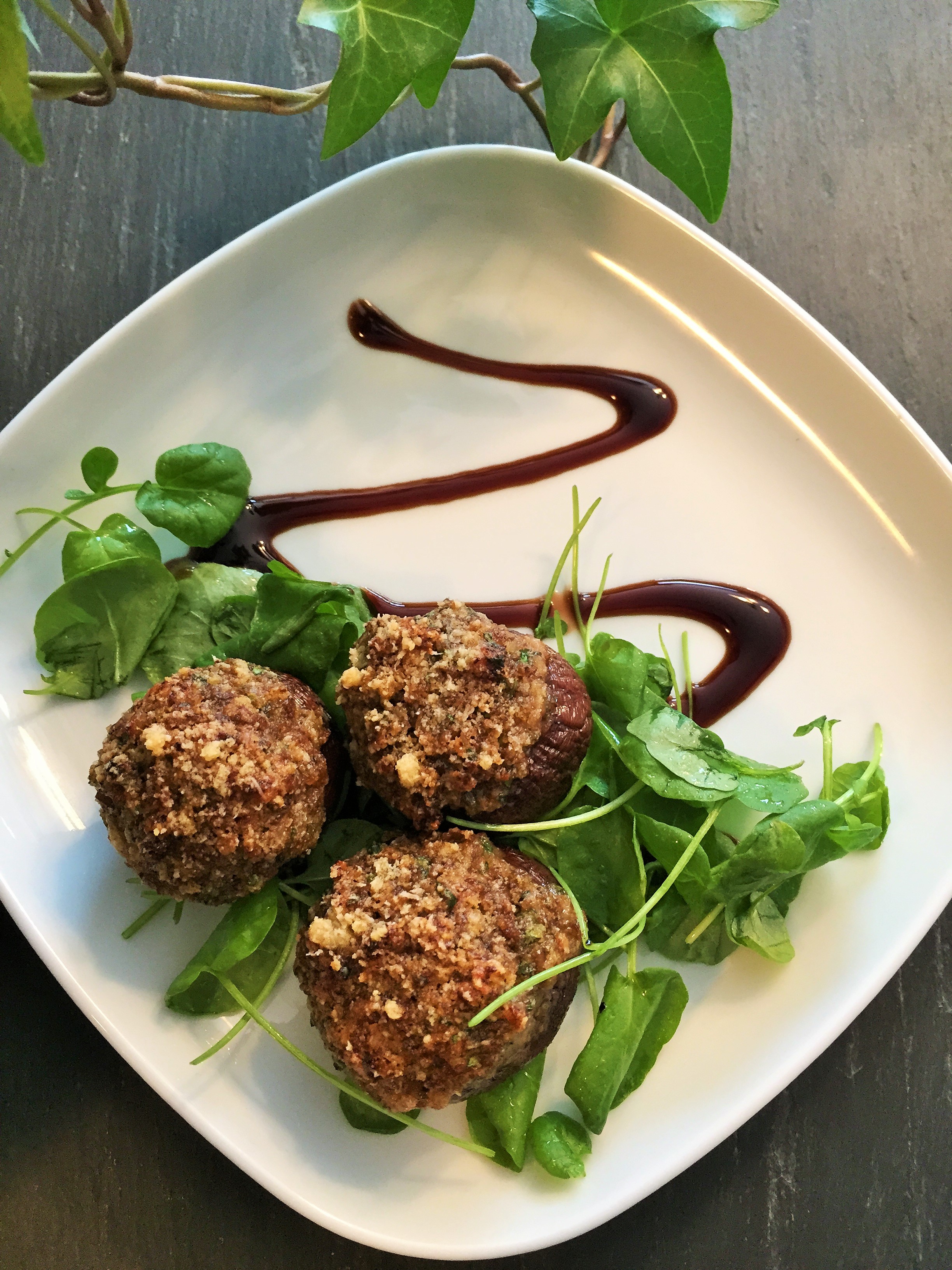
Stuffed Creminis with watercress and balsamic reduction!

Stuffed Creminis with watercress and balsamic reduction!

As a techie, I have often been heard to utter the perhaps tiresome phrase - "There's an App for that".  In this case, we're talking about an Appetizer - Stuffed Mushrooms. I'm presenting them here as an appetizer, but they also work well as a side to a range of entrées - an omelette, roast pork, steak, fish - even next to a bean dish. Choose slightly smaller mushrooms and they become hors-d'oeuvres. Serve several and they can even be the main course! They work at all meals - a (posh) breakfast, or at lunch or dinner.

The brown-ish Cremini mushrooms lie on a continuum between white button mushrooms and larger Portobellos. They are older than the former and younger than the latter, and may be priced a bit higher than buttons, but chefs tend to prefer them to white buttons for their taste and texture. 

Mushrooms are loaded with nutrients and a low calorie food (though the stuffing ingredients are going to add a little bit to the calorie count). “Though neither meat nor vegetable, mushrooms are known as the "meat" of the vegetable world” (source) and are often a staple in a vegetarian diet – offering welcome texture and flavour.

There used to be a golden rule that mushrooms should be packaged / stored in a bag, but over the last few years many stores offer them pre-packaged and covered in plastic!? I have no idea why that became ok – but I always prefer to buy them loose and in a bag. (I suppose some people might be concerned about shoppers “touching” mushrooms that they don’t buy.) Mushrooms purchased in plastic should be stored in a paper bag once home. Check out Mushrooms Canada for tips and recipes.

The appetizer pictured here is served with greens. I was going to use arugula, but could not get them from my source, and instead used watercress. Turns out watercress is also loaded with nutrients, and hundreds of years ago was a “go to” remedy for scurvy. It must have been abundant at one time, whereas now it can be harder to source and more costly than other greens.

I’m not a big fan of “naked greens”, but did not want to interfere with the mushroom flavours. To a small bowl of watercress, I added less than a teaspoon of Canadian Maple Syrup. With a clean hand – in fact it helps if it is a touch wet – gently swish the cress and they quickly become covered with the maple syrup – enough for a gorgeous appearance / presentation and a subtle flavour that people will never guess. A balsamic reduction (which can be made, though is easier purchased) gussies it up – and further enhances the eating experience.

Click here for the recipe and enjoy this appetizer, side, main – whatever seem APPropriate :-)

If you enjoyed this read and/or this recipe please click on "Like". I invite you to Share and Comment!
Breaking the Bread Jinx

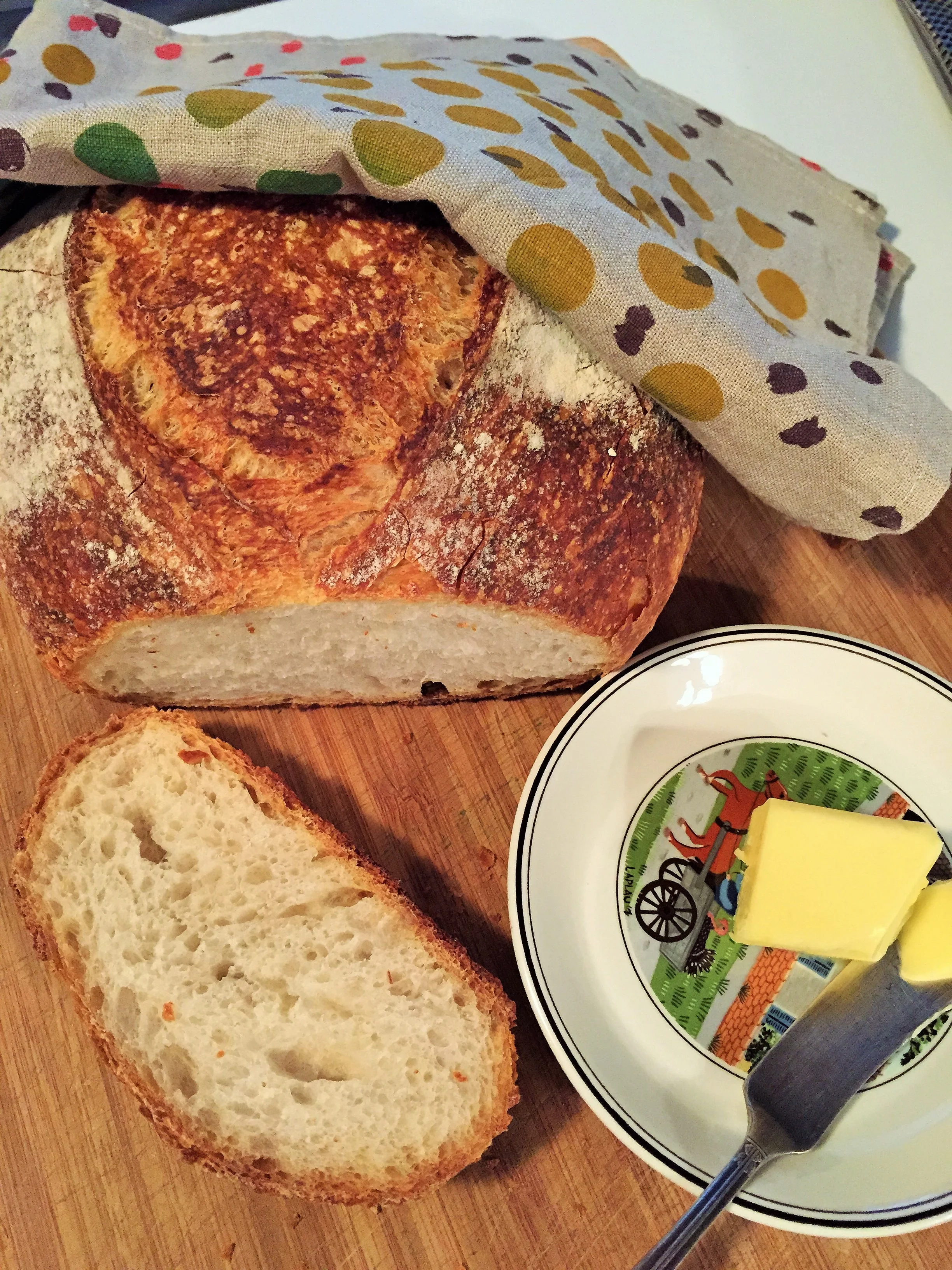
ATK (Almost) No Knead Bread 2.0

ATK (Almost) No Knead Bread 2.0

Apart from Irish Soda Bread, which uses no yeast and is easy, yeasted breads have for some reason challenged me. Yeast never did that bubbling thing. I could never get the dough to rise. For a long time I gave up. Perhaps not a big deal – except in a previous blog post I mentioned that in the “last supper game” – I’d be wanting bread – so one would think I should be able to make it. Before Christmas (2014) I announced to my sweet DIL that one New Year’s resolution was to successfully bake bread. She ensured that bread flour from a fab Kensington Market bakery – Blackbird – appeared under the Christmas tree. They say if you really want to achieve a goal announce it publicly. If you are feeling ambivalent – maybe best to tell no one – haha. Added to this, America’s Test Kitchen (ATK) published their “All Time Best Bread Recipes”. The planets were aligning – time for me to tackle bread-making and break the jinx.

The bread recipe that motivated me was ATK’s (Almost) No Knead Bread 2.0. Why “almost”? Why 2.0? 

"No knead bread" got a lot of publicity back in 2006, from an article by Mark Bittman who, among other things, writes for the New York Times. He interviewed and recorded for posterity a no knead bread recipe from Jim Lahey of NYC’s Sullivan Street Bakery. They debated whether a 4 year old could make it – and Bittman concluded it would have to be at least an 8 year old. Central to the recipe is that time replaces the work done by kneading – and we’re talking here of a long time – Lahey advises about 18 hours. I knew of this story – listened to a CBC Radio personality trying to master this bread - but did not take the plunge until ATK’s 2.0 version.

ATK is a “test” kitchen and they test, test, test to perfect recipe variables and outcomes.  Their changes to Lahey’s recipe are primarily: first rise can be 8-18 hours, they add beer to boost flavour, and they knead the dough after the first rise (only) 10-15 times. The dough requires a second rise. It is baked in a Dutch oven. I began this on an evening around 8:00 and dinner (supper) the next day was accompanied by a fabulous bread. ATK offers variations: olive / rosemary / Parmesan; cranberry / pecan; seeded rye; whole wheat.

I have since tried another bread recipe which will appear in a future blog – comparing the two, this one had a great (better) crust and great flavour. Click here for the ATK 2.0 recipe and my tips. (Click coming soon...)

If you want to read more about the Bittman / Lahey story here are some links. The original article; Lahey's recipe and the video.

This satisfying baking adventure is not likely to turn me into a regular bread maker. I still buy bread. Compared to decades ago, there seem to be a proliferation of bakeries these days. [2020 Update - Love the Potato Sour Dough from 193 Bench, and Cafe Baffico makes great bread and croissants.]

When it comes to bread, for me it has to compete with a food memory – bread eaten in Hungary decades ago. I am not sure why that was so good. The closest thing I have found here is the Potato bread from de la terre bakery.   If you visit their little storefront in Vineland, you may be disappointed by what’s left. Almost easier to find their bread at Goodness Me, Picone’s and the Hamilton Farmers' Market or these other locations.   See also Best Breads in Toronto. Would be a interesting project to check out each of those TO bread bakeries!

Might be fun to make this blog a bit interactive. Use the Comments tool below to share your favourite bread. Comments do not require you to leave your full name.

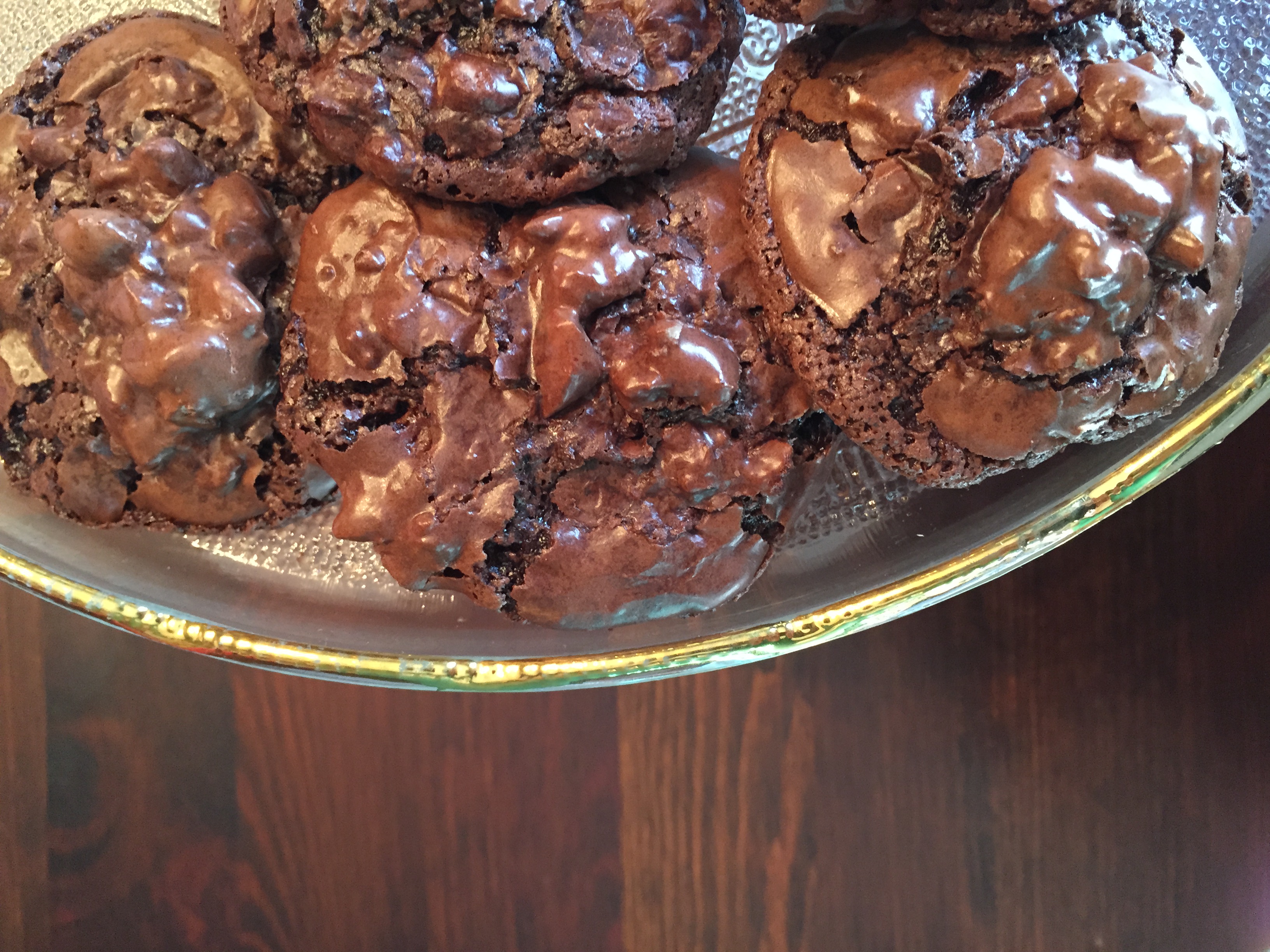
Chocolate Walnut Cookies – bet you can’t eat just one…

For several years, we have travelled to NYC annually to visit our favourite scholar. One year we finally decided to visit Grand Central Station/Terminal. The iconic station is itself a sight to behold, but the visit is enhanced by checking out the Grand Central Market on one end, and the shops at the other end. It was the "year of macarons", and I was drawn to the displays of a shop called Financier Pastries. In addition to buying gorgeously coloured macarons, I grabbed a wee bag of chocolate walnut flourless cookies. They were so wonderful, I had to find a recipe replicating them. For years, I was using the one from Epicurious. Recently, I have found a recipe that is the original.

The cookies contain no flour, so are gluten-free and Passover friendly. Because the recipe uses egg whites, there is a sort of meringue chew – combined with texture from the walnuts - and the inside is moist and fudge-y. The crackle top retains the shiny quality. It is gorgeous to look at, and tastes heavenly. 

All sources I found referred to these as Payard’s cookies.  They write about this revered pâtissier as if he’s dead, but apparently not. He has several shops in Manhattan (and Japan and Korea). Am feeling red-faced that I have never tracked down one of the locations – will be on the list for this year.

Quirky trivia – the Financier Pastry product line includes Payard’s cookies, and Payard’s product line includes “Financiers”.  The website for Financier Pastry says their name is inspired by the financial district where their flagship store is located, but the name also evokes their custom - with each coffee they give a small French pastry in the shape of a gold bar called a “financier”. Payard also sells financiers – not in the shape of a gold bar. In fact, they look a bit like cupcakes, and Smitten Kitchen offers us a recipe for this treat which uses almond flour.

The cookies I make tend to be about 1.5 inch diametre - though if the batter is a bit runny, the cookies tend to flatten and spread to about two inches.  Apparently, the original Payard cookies, that he sells to this day, are huge – four inch diametre. That being the case, "one" might be all any person could eat.

I went through a spell of making these often, and recently dusted off the recipe to make a batch for this blog entry. I was alone in the kitchen, tasting the first batch and practically startled myself with my “out loud voice” making all sorts of mmm, nomnom sounds. Love these cookies – resistance is futile!

Click here for the recipe. It’s another simple one that can be mixed by hand or mixer. Add it to the list of recipes that use up leftover egg whites.